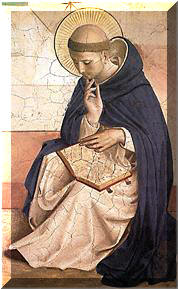
 St.
Dominic
St.
Dominic
Written by
Fr. Martin J. Gleeson, OP
Prior Provincial
Wednesday, 07 September 2005
Who Was Dominic de Guzman?
Young Dominic
St. Dominic was born in Spain in 1170 of the illustrious house of Guzman. After
graduation from the University of Palencia and ordination to the priesthood, he
became a canon of St. Augustine and superior of the canons in the cathedral of
Osma. Passing through southern France with his bishop in the year 1203, the
young canon was shocked to witness the spiritual horrors wrought by the
Albigensian heresy. It was in this storied domain of the troubadours that our
zealous Castilian discovered his vocation and laid the foundation of the Order
of Preachers.
A Preachers Response
To perpetuate among these benighted souls his future apostolate Dominic founded
a three-fold religious Order, one for the converted Albigensian women at
Prouille, one for an apostolic band of preachers, and another for men and women
known as Tertiaries living in the world as lay Dominicans affiliated with the
Order. Dominic, like St. Bernard before him, found the heretics unreceptive,
stubborn and hostile, but the barking of the “Watchdog of the Lord” continued
loud and clear, while his hunger for souls grew stronger.
The Holy Preacher
St. Dominic's humility, fatherly kindness, patience and joyfulness under
persecution impressed even his enemies who at times mocked, spit at him and
pelted him with stones or mud. Since he could not shed his blood for their
salvation, he fasted, took the discipline during his night-vigils of prayer, and
walked barefoot from village to village preaching the faith. During his
lifetime, he healed the sick, raised the dead, multiplied food, and in public
debate proved the truth of his doctrine by miracle. When threatened with death,
he would reply: “I am not worthy of the martyr's crown.” He twice rejected a
bishopric, and he enjoyed a warm friendship with the Poor Man of Assisi which is
still commemorated in the liturgies of the Franciscan and Dominican Orders.
Several times he was consoled and strengthened in his apostolate by apparitions
of Christ and his Mother.
Four times Dominic journeyed on foot to the Eternal City where Pope Honorius III
confirmed his Order and granted him the convent of St. Sixtus for his nuns and
that of Santa Sabina for his friars. He made foundations in university cities to
ensure an adequate education for the brethren. On August 15, 12 17, he scattered
his men to various parts of Europe saying: “If grain is sown it bears fruit, but
if it is stored it rots.” The Founder summoned two General Chapters in 1220 and
1221 and lived to witness the amazing expansion of his Order. He was felled by
sheer exhaustion after his last mission in Lombardy at the age of fifty-one.
After making a general confession, he said to his weeping brethren: “Do not
weep, my children, I shall be more useful to you where I am going than I have
ever been in this life. I thank God who has preserved me in perfect virginity to
this day. Have charity, guard humility, keep voluntary poverty.” He fell asleep
in Christ on August 6, 12 21, at Bologna where his relics now lie in a marble
tomb of exquisite beauty, the work of Nicholas Pisano (1160-1265). The tomb was
later embellished by Michelangelo and other artists, and may be seen in the
Dominican church at Bologna. From heaven, the Patriarch fulfills his promise to
answer the prayers of all who invoke him.